Food, Glorious—and spicy and strange—Food

Chunks of fried fish with ginger, lime, chile, shallot, peanuts and coconut.

Whenever we travel to a foreign destination, we encounter new flavors and foods. It is part of experiencing another country and culture, and for me, often a highlight of the journey.

On our recent trip to Asia, each of the three countries we visited–

Thailand's large pomelos.

Thailand, Indonesia and Hong Kong–offered spices, fruits and let’s just say–edible body parts of meat–that we’d never previously encountered.

During a visit to the fruit and vegetable market in Bangkok, we stopped frequently to taste some of the fruits. The rambutan, longan, mangosteen and pomelo were favorites for the kids. I was in awe of the heaping bunches of lemongrass, a plant that is frequently used in Thai cuisine, and which is broken, or bruised, to evoke its flavor. I also couldn’t take my eyes off a woman working speedily to cut flat pieces of fresh ginger into mounds of julienned slices. The colors, textures and smells were intense and only made me hungry.

A woman slices fresh ginger.

In Thailand, we enjoyed traditional dishes like pad thai and panang curry, soups with coconut milk and rice noodle dishes on which we’d squeeze kaffir limes. It was hard to avoid the heat from the chiles, and both Nicole and Simon developed an appreciation for it as we continued on our dining adventures.

When we arrived in Bali, one of the first things we discovered is that the passion fruit there is sweet–a stark contrast to the sour passion fruits we’d eaten in Thailand and other countries we’ve visited in the past, like Costa Rica and Nicaragua. In Bali, we also encountered the jackfruit and snake fruit (salak).

Tasting a longan fruit at the market.

We discovered heat in Bali too, exploring dishes that use one of three types of chile peppers (the smallest, tabia krinying, being the smallest and most powerful). Fish curry, sauteed greens with tomatoes and chiles, and anything rolled in banana leaves were highlights of our Balinese meals. We also encountered palm sugar (gula merah), a caramel-flavored natural sugar, and learned that nutmeg helps you sleep (who knew?).

Although we went out for an Italian dinner in Hong Kong for a change of

Fresh rambutan fruit.

pace, the chinese food we ate there was most definitely the best we’ve ever had. Dim sum was an experience we won’t forget. We asked the waiter for some direction, and my risk-taking husband nodded yes when the waiter suggested chicken feet and roasted pigeon. I was up for the pigeon, but remain unsure why they feel it’s necessary to place the roasted head on the plate along with the rest. Are you supposed to eat the head? We did not, but just looked at it warily, and stuck to the parts we were familiar with.

Palm sugar, lemongrass and other Balinese ingredients.

The Peking duck we ate on our final night was incredible. After mouth-watering scallion pancakes and an assortment of unnecessary appetizers, we were presented with our deep brown, crispy duck–then removed to be sliced. When the duck returned, it was served with its traditional accompaniments: pancakes, spring onions, and hoisin (or sweet bean)sauce.

Dim sum--chicken feet and pigeon head included.

Back in the States, we are enjoying the final weeks of barbecues and summer fruits–juicy plums, peaches and nectarines. But we miss our morning fruit plates from Asia, the colors, shapes and flavors we’ll savor for a long time.


Share

Hong Kong: In Constant Contrast

Emily and Nicole at Stanley market.

Hong Kong felt like a two-day course in contradictions: towering skyscrapers versus green mountains and open sea, art galleries and high-end fashion boutiques versus street markets and souvenir kitsch, Colonial history versus modern architecture, Starbucks versus tea houses.

With Hong Kong’s fast-paced, financial center typically the city’s major focus, it was fascinating to experience the city as a tourist. The world’s most vertical city, it seems that each and every skyscraper has a mall in its lower floors, making it impossible to avoid passing through or eating in one of them—and needless to say, my teenage daughters were very happy that our uber-contemporary hotel, the Upper House, was located directly above the swanky Pacific Place mall.

Rich studies the MTR ticket machine.

During our visit, we took full advantage of Hong Kong’s public transportation—the most efficient and highly used (over 90 percent of daily journeys are via public transport) system in the world.

Our first night, we took the Star Ferry–operating under its name since 1898–from Hong Kong island where our hotel was, across Victoria Harbor to Kowloon. We walked through the Ocean Place mall, maneuvering our way through the shoppers (predominantly locals) to an Italian restaurant, Spasso, which had an outdoor terrace. We had a great view of Hong Kong island and a laser beam light show in the sky that takes place every night at 8 pm. We made our way back to the hotel via the MTR, Hong Kong’s subway system. It took us a while to figure out the automated ticket machine, but otherwise, it was a quick ride and only one stop from Kowloon to Admiralty station, from

Eating dim sum.

where we walked through the Pacific Place mall and up to our hotel. Counseled by a friend of a friend who lived in Hong Kong for years, we went to Lei Garden for dim sum on our one full day in HK. Located in the IFC (International Finance Center) mall, it was a great experience to eat dim sum surrounded by local families. Our waiter helped us make sense of the menu, and some of us attempted to be daring by experimenting with dishes, such as chicken feet and roasted pigeon.

Our daring foodie tries sauteed chicken feet.

We then hopped on the local #6 double-decker bus, opting for a circuitous route to the Stanley market so we could see more of the city. Sitting next to a man named Kenny—a name he adopted when he studied in Liverpool years prior—I was able to ask questions about life in Hong Kong. A mechanical engineer who worked an early shift and was now on his way to the beach, Kenny pointed out some sites and explained that many people go to the beach or countryside on the weekends. One of the nicest beaches we passed (“near where the wealthy ex-patriots live,” remarked Kenny) is called Repulse Bay.

Admiring Stanley beach.

We parted ways with Kenny at the Stanley terminus, and walked a block to the street market, loaded with stalls selling Chinese souvenirs, jade, silk clothing, electronics, etc. We found our way out of the market and were stunned by the beauty of the beach and the bay, lined with a boardwalk and some cafes.

To compete with the public transport’s efficiency, taxi rates are very affordable, so as a family of five we sometimes opted for a taxi and paid the same or less than we would on a subway (though it’s much less efficient from a time perspective). From Stanley, we took a taxi up to the Peak, one of Hong Kong’s most popular tourist attractions. It was over 90 degrees, extremely humid and packed with people, so we took some photos of the vista below and then hopped on the tram down the mountainside. A 10-minute walk from the tram station through Hong Kong park and we were back at the Upper House.

The view from the Peak.

For our final night, we reserved a table at Peking Garden, a restaurant just below our hotel in the Pacific Place mall. We ate the most delectable Peking duck, scallion pancakes, and sautéed bean sprouts, paired with a delicious Australian shiraz. After toasting our travels at dinner, Rich, Simon and Nicole couldn’t keep away from seeing Harry Potter in 3D just one flight up. Emily and I walked through the mall, took the elevator up 44 floors and went to bed. The next morning we’d be going home.

Share

Paradise at Jimbaran Bay

The colorful fishing boats on Jimbaran Bay.

Our second and final destination in Bali was Jimbaran Bay. A coastal resort area on the southern part of the island, Jimbaran is known for its colorful fishing boats, beautiful beach, gentle surf and seaside grill restaurants.

After our previous activity-filled days in Ubud, northern Thailand and Bangkok, we were ripe for a few days to relax on the beach and do little else. However, while swimming in the ocean, we spotted a surfing instructor giving a lesson and asked him if he’d be willing to teach the kids. For a 2 ½ hour lesson, Dave from San Diego—who’s been in Bali for 5 years and also runs the Bali Kids Camp—charged very little money and was a great instructor. The kids had a blast and did great, as seen in the photos.

Other daytime activities include Balinese beachfront massages (60 minutes for $20!!), long walks/runs, and getting stung by a jelly fish on the leg (that was me).

Each evening, a wide stretch of beach converts to seaside grill restaurants with candlelit tables reaching toward the water. After choosing a table at one of the many restaurants, diners go up to the grill and choose their freshly caught fish—barramundi and red snapper—and seafood from its display on ice. While waiting, people drink and nibble on nuts until the grilled fish and sautéed greens appear.

After dinner, we walk along the beach back to our hotel, the Four Seasons Jimbaran, which lies at one end of the long beach. The hotel is dotted with

Nicole takes a run past the tables being set up for the evening.

thatched roof villas, each decorated with locally made teak furniture and exotic batik fabrics.

Here, we continue to indulge in the amazing local fruits every day. From dragon fruit and passion fruit to mangosteen and snake fruit, it will be hard to leave these exotic treats behind.

I’d be lying if I said I was ready to leave Bali. Six days isn’t nearly enough and I look forward to returning and exploring more of this beautiful paradise.

Next stop: Hong Kong!


photo source

Share

Batik and Biking in Ubud

Simon, Rich and Made

Thanks to a contact that Nicole made last summer while in Vietnam, we were fortunate to make the acquaintance of Made (pronounced Mah-day)–a Balinese taxi driver and occasional Backroads shuttle support staff member–who helped us make our way around the Ubud area during our three day visit. Spending time with Made also opened up a native window into Balinese culture, traditions, family and religion.

About 90 percent of the Balinese are Hindu, with the remaining 10 percent divided among Muslims, Buddhists and Christians.

A rice paddy at our hotel.

Made’s village was conveniently located only minutes from our hotel, the Four Seasons Sayan, which is built into a hillside dotted with rice paddies along the rushing Ayung river in central Bali.

Made explained that his family—his wife and two children, his parents, and one of his brothers and sister-in-law and their kids—lives within a typical Balinese family compound. Hindu tradition deems that the kitchen is placed to the south, the adult married couples dwellings are built to the east, and the temple to the northeast.

A monkey eats a banana atop Nicole's head.

People in Bali are given one of only four names, each one specific to birth order. The first child is named Wayan, the second born is Made, then Nyoman and then Katut. Our Made was actually the 6th child, so he and his 2nd born sibling are both named Made. This, we decided, is an excellent concept for Rich who often has trouble remembering names.

Ubud is considered the artistic and cultural capital of Bali. We visited some art galleries, a Monkey park, and a small batik factory in Pejeng Village, where each of the kids was able to choose their patterns and make one of their own.

Emily makes batik, using boiling wax.

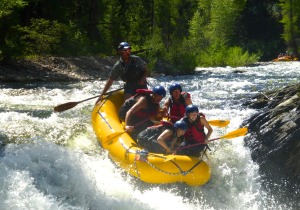
Because of its proximity to Bali’s volcanoes and the Ayung river, it’s very well suited for those—like us—seeking adventure. We went whitewater rafting with a company called Sobek, which took us down the Ayung and its Class II and III rapids. Our rafting guide, another Made who’s nickname is Lowly, energetically serenaded us down the river. We all paddled, yet he managed to maneuver us for a refreshing spritz under the occasional waterfall.

Our last morning in Ubud, Made picked us up at 7 am and we drove about 45 minutes up to the town of Kintamani from where we could view Bratan, one of Bali’s two active volcanoes. We

Simon fills in gaps.

unloaded the bikes from the top of the car, and from here—with Made’s friend Wayan (a first-born) as “car support”—we rode back to the town of Ubud.

Our bike ride took us through many villages, where we shouted hello in response to every child and farmer’s smile and greeting along the way. We passed by countless numbers of bright green rice paddy terraces, as well as fields growing coffee, cocoa, peanuts, oranges and kafir limes.

While riding, we also came across groups of school

The final products.

children marching in unison and chanting what sounded like cheers. Made explained that they were practicing for upcoming competitions which will take place on August 17th, Bali’s independence day.

One of my favorite sights during our ride was a pick up truck loaded with about 40 school kids in their colorful uniforms. We followed the truck for a while, marveling as it stopped in each small villages to drop a child or two off. The kids would jump off the truck when it was their “stop.” It was their version of a school bus–no seats let alone a seatbelt!

Rafting down the Ayung river.

Once back in Ubud, our reward after the cycling was lunch at Naughty Nuri’s Warung, famous for its grilled meats. We also had delicious meals during our stay at Casa Luna for lunch and Indus for dinner, where we ate the most flavorful curries and flat noodle dishes.

Cycling through a rural village.

Next stop, Jimbaran Bay on Bali’s southern coast…


Share

Sweet, Salty, Sour, Spicy–Balinese Cooking School


Yude, our teacher.

One cannot live well, love well or sleep well unless one has dined well.  –Virginia Woolf


It took me just one whiff of jasmine, one bite of a curry dish, one glance at the array of batik, and one smile from a local to get me completely hooked on Bali.

Intrigued by the thought of learning an entirely new and foreign cuisine, I booked Nicole, Emily and I into the Casa Luna cooking school to learn some Balinese cooking.

Situated in the Honeymoon Guest Suites in the town of Ubud, this small inn also offers morning yoga classes. We quickly signed up for a pre-culinary  hour and a half of asanas, taught by a young instructor named Ketut. Throughout the class, with roosters crowing and school children chanting as background noise, we breathed, stretched and balanced. All the while, Ketut was imploring us to use yoga in our minds even when we are not on the mat, emphasizing its mental and spiritual importance as much as the physical. He also showed us a yoga secret—which I will undoubtedly show to my yogini friends—to add flexibility to the forward bend.

After yoga, we made our way to the cooking class in an open air pavilion

Our Balinese cooking ingredients.

surrounded by old Balinese temples and courtyards, yet equipped with modern cooking equipment. A long table was set up with pitchers of water and freshly made Hibiscus juice, which our teacher, Yude, demonstrated. It was wild–she took the petals of a giant red hibiscus flower, steeped them in boiling water in a glass which turned a shade of dark purple. She then added some salt and the purple turned bright red. Some simple syrup and voila.

There were about 20 students in the class, and we each introduced ourselves before

Emily juliennes vegetables.

beginning. We were the only Americans in the class—others hailed from Australia, Canada, France and London—and we have found this across the board, practically no Americans in Thailand or here in Bali.

Yude then took us through each ingredient with which we’d be cooking—such as three different types of ginger, three sorts of chile peppers and a variety of spices, nuts and seeds—offering substitutions for those she assumed we wouldn’t be able to find. Our menu consisted of the following:

  • Sweet and Sour salad (Rujak)
  • Grilled Fish in Banana Leaves (Pepesan Ikan)
  • Fish Curry (Tuna Mesanten)
  • Spinach in Tomato-Chili Sambal (Kangkung Pelecing)
  • Raw Chili Seasoning (Sambal Matah)
  • Carrot and Cucumber Salad (Acar)
  • Black Rice Pudding (Bubur Injin)

Yude speaks beautiful English, has a great sense of humor, and is a very proficient

Nicole grinds curry paste.

teacher. She explained how Balinese cooking is a balance of sweet, sour, salty and spicy, which couldn’t be more true. The blend of these characteristics is so delicate and varies in nearly every dish, with one flavor overpowering in a specific recipe, yet succumbing in the next. Yude had us all laughing as she added a pinch which in Bali amounts to a handful, or a splash, which she converts to a cup full.

Part of the class involved Yude demonstrating techniques, while at other times we each participated—rolling fish in banana leaves and grinding ingredients (lemongrass is probably my favorite) in a Balinese mortar and pestle (larger and flatter then the traditional Mexican one and easier for grinding versus crushing).

We rolled fish in banana leaves.

The result was a scrumptious meal (Rich and Simon appeared at the end and were invited by Yude to reap the benefits of our efforts) that we shared with our fellow classmates around the long teak Balinese table. I only hope to recreate some of these dishes once back at home…

Share

Driving Miss Lana


At the end of this trip, I will add “soreness from elephant driving” to my growing list of sports and age-related ailments. Riding on the neck of Lana—a 23-year-old female, Asian elephant—for the past two days has been a thrill, and worth every sore muscle. Especially, when you get to follow the mahout trainings with a Thai massage…in Thailand.

When our flight from Bangkok touched down in northern Thailand’s city of Chiang Rai, it was pouring rain. Although it’s rainy season here, the continuous downpour was particularly unusual and due to a passing storm making its way from Vietnam.

Upon our arrival to the Anantara Golden Triangle resort, which sits on a hillside overlooking the Mekong River and the country of Myanmar (still referred to as Burma here), we learned that the Golden Triangle refers to the point where three countries—Thailand, Myanmar and Laos—meet.

On our first morning, we were met by Seng, the intrepid Elephant Camp supervisor. Seng, who was born in a local hill tribe, speaks English and is a great

Simon, Emily, Nicole and Seng, our mahout leader.

photographer. While we thought we’d be making our way on foot to the elephant camp or catching a ride on a hotel buggy, we were instead picked up by five gigantic elephants and their respective mahouts, or trainers. We each mounted an elephant and were instructed to sit high on its neck and not on its shoulders for lack of balance—fairly ironic as I was sure I was about to fall off and hit the pavement no matter where I sat. I held on for dear life, resting my knees on top of Lana’s ears and squeezing tight with my legs (hence the soreness).

By the end of two hours, I wasn’t only comfortable atop Lana’s neck, but happily singing to her and effectively giving her commands in Thai to go forward (bai), turn

Driving practice on a mini elephant slalom course.

(ben), stop (how) and reverse (toy). We learned three different methods and commands to get on and off our elephant, each one as fun as riding a roller coaster (I realize that is not fun for everyone). Periodically, we commanded our elephants to lift their trunk, after which we rewarded them with whole, unpeeled bananas and pieces of sugar cane, one at a time. They flap their ears when they are happy, and do the same when they are hot–their ears acting as a self-cooling system.

Many of these elephants–a symbol of wisdom in Asian cultures–have been rescued by the Thai Elephant Conservation Center (TECC), and about 30 of them currently reside at the Anantara which shares them with the nearby Four Seasons Tented Camp. Seng explained that the TECC rescues them from both the city, where they may be used to make money as attractions, as well as from the wild.

One of the highlights of being a student mahout was taking our elephants to the

Lana enjoyed her bath and gave me a shower.

pond to bathe. Lana loved the water so much that she kept on dousing her self and then giving me a shower too—over and over and over. At one point, she submerged so deeply that I fell off of her and had to climb back on. We were hysterically laughing as our elephants dunked and sprayed and cooled off after all their effort.

Emerging from the pond, we walked along a jungle path and passed through the baby elephant camp. The youngest elephant, Phillip, is 14 months old and stays at the main camp with his mother, but all of the others elephants under 10 years old live in this separate area. As we walked by, each young elephant touched his trunk to ours as if to say hello. On the way back to the hotel, we walked along the manicured paths and Lana—despite her mahout’s rebuke—ripped out a perfectly manicured plant by its root for a little snack.

Baby Phillip and his mom shared some sugarcane.

We bid these gentle giants adieu, ate lunch by the pool and then made our next move. Rich, Nicole and I walked to the Hall of Opium, situated just across the road from our hotel’s entrance. We kept on hearing from other guests that it was “much better than they’d expected,” and we found the same to be true.

A project of the Royal Family to highlight the transformation from this once opium-growing region, the museum seems to be in the middle of nowhere yet boasts some highly sophisticated multimedia exhibitions. Three floors take you through the history of opium, the Opium Wars, a Hall of Reflection and some modern case studies. We exited the museum into the pouring rain and made our way back to the hotel.

The next morning, we (minus Rich who’d had enough of riding elephants) trekked with our elephants to the top of the hill where they sleep every night. At the top, we had a beautiful view of the Mekong, Burma to the right and Laos to the left. We dismounted our elephants to take in the vista, cool off with some water and take a few photos.

Descending the hill was a bit harder than going up, but we were pros by now. Once back at the camp, we said goodbye to our elephants, and made a donation towards their care.

Share

Humidity & History in Bangkok

In front of the Grand Palace.

Bangkok is hot and crowded, yet our senses are in a thrilling state of overdrive–everything we see, smell and taste feels simultaneously strange and fascinating. Even the 15-hour flight from Newark to Hong Kong had its excitement, as a non-English speaking flight attendant accidentally served our 17-year-old a double vodka on the rocks with a twist rather than the club soda with lime she had ordered. After a large mid-flight dehydration-provoked gulp (it was supposed to be sparkling water, remember?) her eyes widened with a startle. Pretty ironic that it happened to the daughter of the Drinking Diaries co-editor.

We started our day in Bangkok with a visit to the Grand Palace (the only Thai destination my 10-year-old son is eager to see, thanks to the “Hangover 2” trailer). Escorted by a lovely guide from Adventures Asia named Eng—who perfected her English as an au pair in Philadelphia—we made it through the packed streets from our hotel, the Sukothai, to the palace in about 30 minutes. Bangkok is renowned for its extreme traffic congestion, and although we were surrounded

by cars, buses, motorcyle taxis (no helmets necessary and about 50 cents for a five minute ride), tuk-tuks (more on these later), the city also boasts an efficient subway and Skytrain system. Along the way, and with a respite from the high humidity in an air-conditioned vehicle, Eng educated us about Thai history, its politics—the Parliament is expected to appoint a 45-year-old female prime minister next week—and its well-liked Monarchy (King Bhumibol Adulyadej, the currant king did, however, ban The King & I, about King Rama IV, after its release in the 1950s for being “too Hollywood,” although Eng got to see it while living in the U.S.)

Eng explained how Thai people tend to be taller than the Chinese (especially the younger generations due to drinking more milk) and have darker skin, like our bus driver, Bae, compared to Eng’s paler skin, typical of her Chinese dissent. Bangkok’s crowded streets are due to the city’s size and population, amounting to 10 million people in a 2,500 square kilometer area. Roughly the size of Texas, Thailand’s population is 65 million and here in its capital, the architecture is largely influenced by China and India.

Catching sight of a smattering of Buddhist monks in their bright orange robes, Eng explained their look and lifestyle—shaved head and eyebrows, can’t be touched by women (even their mother), no food after lunchtime, no entertainment, sleeping on hard floor, and a focus on discipline. Nearly all men choose to be ordained at one point in their life (our driver, Bae, had done so for one month at the age of 24), and afterward can marry and live a more conventional life. Most monks are young because if this path is chosen before one is married, it is said that good karma will go to one’s parents; if one chooses to be ordained after marriage, the karma goes to the wife. (Simon, were you listening?)

The Thai language, we learned, is made up of 44 characters and 28 vowels, but the fascinating part is that tone makes all the difference. Each word as a minimum of three tones, so the same word, sua, for example, means mat, t-shirt and tiger, depending on how it’s pronounced. We struggled to memorize a few important words (sowatica=hello/goodbye; kopkunca=thank you), though our eldest daughter focused on learning “how much?” and “too much?”

The Grand Palace, sitting on 65 acres in the middle of the city, dates back to 1782 and was the King’s residence until 1910. In Thailand, the King is considered God’s creation and put on earth to help mankind. The current king is 85, and similar in age to Queen Elizabeth with whom he is apparently a good friend.

The towering Reclining Buddha

We walked around the palace and its chapels made of gold-leaf mosaics, painted enamel and brilliant glass tiles. A big draw is the Emerald Buddha, which is actually made of jade. We also visited the Wat Pho—home of the first university, Thai massage or acupressure, and the gigantic Reclining Buddha, measuring 50 feet high by 150 feet long. Since the number 108 is a sacred number in Buddhism, each of the kids walked along a row of 108 pots, dropping a Thai coin in each as a donation.

To get a bit closer to the native traffic, we took a ride in a tuk-tuk–motorized rickshaws that run on propane–from the palace to our next activity, a ride on a long-tailed boat on the Chao Phraya River. This was a chance to experience life on the Thai canals and to see the disparity between the poorer homes and the wealthier ones, which continue to exist side by side. After the crowds at the Grand Palace, the breeze was especially nice.

By this time we were starving, and sat down for lunch at a local riverside restaurant called Khun Kung Kitchen. We asked Eng to order for us and we gorged on a variety of Thai dishes, such as phad thai, eggplant with hot chiles, shrimp pancakes, chunks of seabass which you put into a large bitter leaf (chapoo) and add bits of ginger, lime, lemongrass, coconut, chile before rolling it up and eating it. Deelish.

lunch!

After lunch, we pushed ourselves a little further through the jetlag  for a visit to the flower and vegetable market. The array and craftsmanship of the flowers—used as offerings to the Buddha—were beautiful. And the veggies and fruit…I went nuts over the loads of lemongrass, and we stopped frequently to sample nearly every local fruit—the longan, pomelo, rambutan, mangosteen and the durian, or “king of fruits,” which has such a bad odor (“like a baby diaper,” is how Eng described it) that it is forbidden to bring it on a plane or into a hotel.

Rambutan and Mangosteen fruits

An afternoon power nap followed the markets. We woke up just early enough to walk a block, take an elevator up to the 59th floor to Vertigo, an open, outdoor rooftop bar. We enjoyed another delicious Thai meal, and then passed out again, ready for an early wake up for our travels tomorrow up north to Thailand’s Golden Triangle. Sowatica (goodbye) for now.

Share

Welcome to Embark–a blog for all things travel and transition related.

As many of you already know, I am a passionate traveler and have been fortunate to incorporate this passion into my career as a writer.

Now, I EMBARK on yet another project. This blog will launch with posts about our family’s upcoming trip to Thailand and Bali, and will continue periodically with not only future travel posts, but also those related to transitions and new beginnings.

While the definition of EMBARK relates to boarding a vehicle, it also means to begin. As life evolves, we do as well–hopefully–and so in between my travels, it is my hope to use this blog to share my thoughts and insights on the various adventures and journeys on which I/we will EMBARK.

And of course, I invite you to share your comments along the way…

~Caren
Share